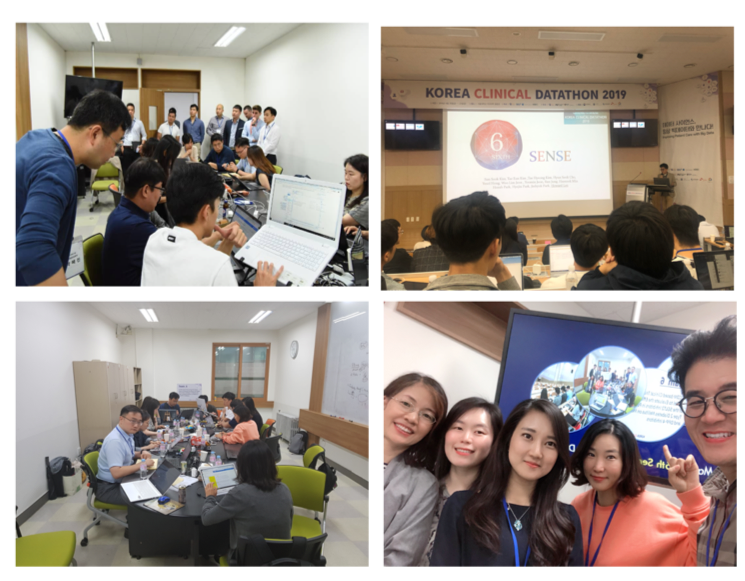
Prof. Howard Lee and Yoomin Jeon participated in the 2nd Korea Clinical Datathon, organized by the Korea National Enterprise for Clinical Trials (KoNECT), September 20-22, 2019. The event was well-attended, which brought over 200 participants, almost doubling the number of those who joined last year. A Datathon is a type of data-focused hackathons, where interdisciplinary teams are challenged to come up with analysis results using their creativity and data science skills within a limited amount of time. The Korea Clinical Datathon aims to bring together clinicians, data scientists, statisticians, students, and those with domain-specific knowledge to brainstorm ideas and to address real-world clinical challenges by applying data analytics technologies. Participants were given access to 3 types of datasets extracted from MIMIC-III (Medical Information Mart for Intensive Care-III), the Seoul National University Hospital VitalDB (vital signs database of surgical patients), and the Ajou University Hospital CDM (Common Data Model).
The first day kicked off with 14 different open-ended clinically relevant questions to address a variety of topics in the medical field. Prof. Lee and Yoomin were on Team 6, comprised of 13 members including four clinicians, three statisticians, one data scientist, and three students. Lead by Prof. Lee, Team 6 came up with the following research question: "Are add-on sodium-glucose cotransporter 2 inhibitors (SGLT2i) efficacious and safe in patients with type 2 diabetes mellitus who are on metformin, sulfonylurea and/or dipeptidylpeptidase-4 inhibitors (DPP4i)?". Using the Ajou University Hospital CDM real-world data, Team 6 has successfully shown that patients with type 2 diabetes mellitus can benefit from add-on SGLT2i treatment in terms of both additional efficacy and comparable safety. Based on the analysis, adding an SGLT2i has shown reductions in HbA1c (approximately 0.76%, very similar to previous publication results) and body weight. In addition, a higher risk of urinary tract and genital infections was found, which are the most common side effects identified with SGLT2i in clinical trials.
On the last day, the sleep-deprived but exhilarated participants presented their findings for a competition. Even though Team 6 failed to win the competition, it was a unique opportunity to get hands-on experience and to learn about possibilities of how machine learning/statistics/data analytic skills can address current challenges in healthcare.











 HOME
HOME